In Kampala, Uganda, limping is one of the most common reasons cat owners bring their pets to the vet. Whether you live in Makindye, Ntinda, Muyenga, Kololo, Bugolobi, Rubaga, or Kira, a limping cat should always raise concern. Limping is not a disease — it is a symptom of pain, injury, infection, or joint disease. And in our Ugandan environment, the causes can range from road accidents and cat fights to thorns, broken glass, and tick-related illnesses.
Many cat owners assume, “It will heal on its own.” Sometimes it does. But often, waiting makes things worse.
Let me share a real case that reflects what we frequently see in Kampala.
Grace, a cat owner from Makindye, noticed her cat Lisa was slightly limping on her front leg. Lisa was still eating, still purring, and occasionally playing. Grace assumed it was a minor sprain from jumping off the sofa. She decided to “monitor her for a few days.”
Days turned into a week.
The limp became worse. Lisa started avoiding putting weight on the paw. She began hiding more and lost her appetite. That’s when Grace brought her to Superior Animal Clinic.
During examination, Dr. Edward, a feline specialist, carefully inspected Lisa’s paw. At first glance, there was no obvious wound. But upon gentle palpation and closer inspection of the paw pad, he discovered a small puncture site. An X-ray confirmed it — a tiny piece of broken glass lodged deep inside the pad.
Lisa had likely stepped on glass while walking near the compound gate.
The glass was surgically removed, the wound was cleaned, antibiotics and pain medication were prescribed, and within days, Lisa was walking comfortably again.
Grace later admitted, “I wish I had brought her earlier.”
This case highlights something very important for cat owners in Kampala:
👉 Limping that lasts more than 24–48 hours needs veterinary attention.
👉 Small wounds in cats can hide serious problems.
👉 Cats rarely cry loudly — they suffer quietly.
In Uganda’s environment — where compounds may have sharp objects, construction debris, hot iron sheets, rough surfaces, and territorial cat fights — limping is common but never trivial.
If your cat is limping in Kampala or surrounding areas like Wakiso, Seguku, or Naalya, early diagnosis can mean the difference between a simple outpatient treatment and a complicated surgical procedure.
Now let’s break down exactly what limping means, what causes it in our local setting, and what you should do next as a responsible cat owner.
What is limping in cats?
Limping is an abnormal walking pattern where a cat avoids putting full weight on one leg due to pain, weakness, or instability.
Why limping should never be ignored
Cats are very good at hiding pain. If a cat is limping, the condition is often already significant.
Common in both indoor and outdoor cats in Uganda
Even indoor cats in apartments in Nakasero or Naguru can suffer injuries from balconies, while outdoor cats in Lungujja or Kawaala face traffic, fights, and parasites.
What Is Limping?
- Abnormal gait
- Favoring one leg
- Holding a leg up
- Walking stiffly
Sudden vs Gradual Limping
- Sudden limping → Usually trauma, fracture, bite wound.
- Gradual limping → Arthritis, joint disease, cancer.
Front Leg vs Hind Leg Limping
Location helps narrow down the cause.
Common Causes of Limping in Cats in Uganda
🦴 A. Injuries and Trauma
1. Road Traffic Accidents
Very common in busy areas like Salaama Road, Entebbe Road, and Jinja Road. These often cause:
- Fractures
- Pelvic injuries
- Nerve damage
2. Falls from Heights
Cats falling from:
- Rooftops
- Balconies
- Trees
Can result in front limb fractures or spinal injuries.
3. Cat Fights and Bite Wounds
Very common in densely populated areas like Katwe and Makindye.
Bite wounds often develop into painful abscesses within 2–3 days.
4. Sprains, Fractures, Dislocations
Sudden non-weight bearing lameness is often a fracture.
🦠 B. Infections
Abscesses from Bites
Swollen, painful limb with fever.
Treatment:
- Drainage under sedation
- Antibiotics such as:
- Amoxicillin-clavulanic acid 12.5–20 mg/kg twice daily for 7–10 days
- Cefovecin injection (single dose, long-acting)
- Amoxicillin-clavulanic acid 12.5–20 mg/kg twice daily for 7–10 days
Joint Infections (Septic Arthritis)
Requires:
- Joint fluid analysis
- Strong antibiotics
- Sometimes joint flushing
🐜 C. Parasites & Vector-Borne Diseases
Tick Infestations
Though less common in cats than dogs, rural and peri-urban areas like Buloba and Wakiso see tick-related issues.
Ticks can cause:
- Joint inflammation
- Fever
- Weakness
- Limping
Treatment includes:
- Doxycycline 5–10 mg/kg once or twice daily for 21–28 days (if tick-borne disease suspected)
- Tick control products (fipronil, selamectin)
🦴 D. Bone and Joint Conditions
Arthritis (Very Common in Senior Cats)
Signs:
- Stiffness
- Reluctance to jump
- Gradual limping
Treatment:
- Meloxicam 0.05 mg/kg once daily (ONLY under veterinary supervision)
- Gabapentin 5–10 mg/kg twice daily for chronic pain
- Joint supplements (glucosamine + chondroitin)
Hip Dysplasia
More common in certain breeds but seen locally.
Luxating Patella
Causes intermittent hind limb limping.
Developmental Bone Problems in Kittens
Poor nutrition can cause weak bones.
🐾 E. Paw and Nail Problems
Very common in Kampala.
- Thorns
- Broken glass
- Scrap metal
- Burns from hot iron sheets or tarmac
Treatment:
- Remove foreign object
- Clean with diluted chlorhexidine
- Apply topical antibiotic ointment
- Bandage if necessary
🧬 F. Other Medical Conditions
- Nerve damage after trauma
- Bone cancer (persistent, worsening limp)
- Severe calcium deficiency in kittens
Signs That Accompany Limping
- Swelling of limb
- Pain when touched
- Crying or aggression
- Fever
- Reduced appetite
- Hiding
- Lethargy
When Is Limping an Emergency?
Seek immediate veterinary care if:
- After road accident
- Cat cannot stand
- Visible bone deformity
- Heavy bleeding
- Deep bite wounds
- Limping lasts more than 24–48 hours
First Aid for Limping Cats in Uganda – What To Do Immediately (And What NOT To Give)
If your cat suddenly starts limping. The goal of first aid is to prevent further injury, reduce pain safely, and transport the cat to a veterinary clinic as soon as possible.
First aid is NOT treatment. It is temporary support before professional care.
At Superior Animal Clinic, we often see cases where incorrect home treatment made the condition worse. Here’s what you should do — and what you must avoid.
✅ What To Do Immediately (Safe First Aid Steps)
Confine the Cat Immediately
Movement worsens injuries.
- Place the cat in a small room or carrier.
- Do not allow jumping or running.
- If you suspect a fracture, restrict movement completely.
This is especially important in busy areas like Salaama Road, Entebbe Road, or Kisaasi, where outdoor cats may try to run back outside.
Gently Examine the Limb (Without Forcing It)
Check for:
- Swelling
- Bleeding
- Thorns
- Broken nails
- Glass pieces
- Hot or painful areas
⚠️ Do NOT stretch the leg or try to “test” the joint.
If the cat resists or cries, stop immediately.
Check the Paw Pads Carefully
In Uganda, common causes include:
- Thorns from compound plants
- Broken glass
- Wire pieces
- Sharp stones
- Burns from hot tarmac or iron sheets
If you see a visible thorn:
- Use clean tweezers
- Remove gently if shallow
- Clean with diluted chlorhexidine or saline
If the object is deep → DO NOT attempt removal. Seek veterinary care.
Control Minor Bleeding
If bleeding:
- Apply clean gauze
- Apply gentle pressure for 3–5 minutes
- Do NOT use tight tourniquets
If bleeding is heavy → emergency care immediately.
Cold Compress for Swelling (First 24 Hours Only)
If you suspect a sprain:
- Wrap ice in a cloth
- Apply for 5–10 minutes
- Repeat every few hours
Never place ice directly on skin.
Safe Transport to the Veterinary Clinic
- Use a secure carrier
- Line with soft towels
- Avoid unnecessary handling
- Keep the cat calm and quiet
Even if the cat appears stable, limping lasting more than 24 hours requires veterinary evaluation.
❌ What NOT To Give Your Cat (VERY IMPORTANT)
Many cats in Uganda suffer severe poisoning from well-meaning owners.
🚫 1. Paracetamol (Panadol)
EXTREMELY TOXIC to cats.
Even a small dose can cause:
- Liver failure
- Swollen face
- Breathing difficulty
- Death
Never give it.
🚫 2. Ibuprofen (Brufen)
Causes:
- Kidney failure
- Stomach ulcers
- Internal bleeding
🚫 3. Diclofenac
Highly toxic and can be fatal.
🚫 4. Human Antibiotics Without Prescription
Wrong dose can:
- Cause kidney damage
- Cause antibiotic resistance
- Mask serious infections
🚫 5. Leftover Dog Medication
Cats metabolize drugs differently.
Some dog medications are unsafe for cats.
🚫 6. Herbal or Unknown Local Remedies
In some Kampala communities, people apply:
- Engine oil
- Paraffin
- Crushed herbs
- Battery acid (yes, this happens)
These cause severe tissue damage and infections.
⚠️ When First Aid Is NOT Enough
Go to a veterinary clinic immediately if:
- The cat cannot bear weight at all
- There is visible bone deformity
- There is a deep bite wound
- The cat has fever
- There is swelling that worsens
- The limp lasts more than 24–48 hours
- The cat becomes lethargic or stops eating
Important Reminder for Cat Owners in Uganda
Cats hide pain. If your cat is limping, it is already uncomfortable.
What looks like “just a small limp” could be:
- A fracture
- A deep abscess
- A glass fragment
- A joint infection
- Nerve damage
Early veterinary care prevents:
- Chronic pain
- Permanent disability
- Expensive surgery
How Veterinarians in Uganda Diagnose the Cause of Limping in Cats
When a cat arrives at the clinic limping, the most important question is:
👉 “Where exactly is the pain coming from?”
In Kampala, we see everything from simple thorn injuries to complex fractures and joint infections. Proper diagnosis is not guesswork — it is a careful, step-by-step process.
At Superior Animal Clinic, diagnosing limping in cats involves combining observation, hands-on examination, and modern diagnostic tools to identify the true cause.
Let’s walk through how it is done.
Step 1: Detailed History Taking
Diagnosis begins before touching the cat.
The veterinarian will ask:
- When did the limping start?
- Was it sudden or gradual?
- Has the cat fallen or been in a fight?
- Is the cat indoor or outdoor?
- Has appetite reduced?
- Any recent fever?
- Any tick exposure?
For example, a cat from Muyenga that roams outside at night may have a fight wound. A cat from an apartment in Kololo may have fallen from a balcony. The environment gives clues.
History often narrows down 50% of the possibilities.
Step 2: Observing the Cat’s Movement (Gait Analysis)
Before handling the cat, the vet observes how it walks.
Questions we silently answer:
- Is the cat avoiding full weight?
- Is it holding the leg up completely?
- Is it stiff in both hind legs?
- Is the problem worse after resting?
Front leg limping often suggests:
- Paw injury
- Shoulder injury
- Elbow issues
Hind leg limping may suggest:
- Hip problems
- Knee (patella) issues
- Pelvic injury
- Spinal issues
Subtle changes in movement can reveal whether it is pain, weakness, or nerve damage.
Step 3: Hands-On Orthopedic Examination
This is where experience matters.
The vet gently:
- Palpates each limb
- Flexes and extends joints
- Checks for swelling
- Feels for heat
- Compares both sides
- Checks muscle symmetry
If the cat reacts strongly when a specific joint is manipulated, that pinpoints the painful area.
We also check:
- Paw pads (for thorns, glass, burns)
- Nails (broken or torn)
- Bite wounds (sometimes hidden under fur)
Many abscesses in cats from Makindye or Katwe are discovered this way.
Step 4: Neurological Examination (If Needed)
Not all limping is orthopedic.
Sometimes the issue is nerve-related.
The vet may test:
- Reflexes
- Toe response
- Spinal pain
- Tail tone
If a cat drags a limb instead of protecting it, nerve damage or spinal injury is suspected.
This is common after road traffic accidents in busy areas like Entebbe Road or Jinja Road.
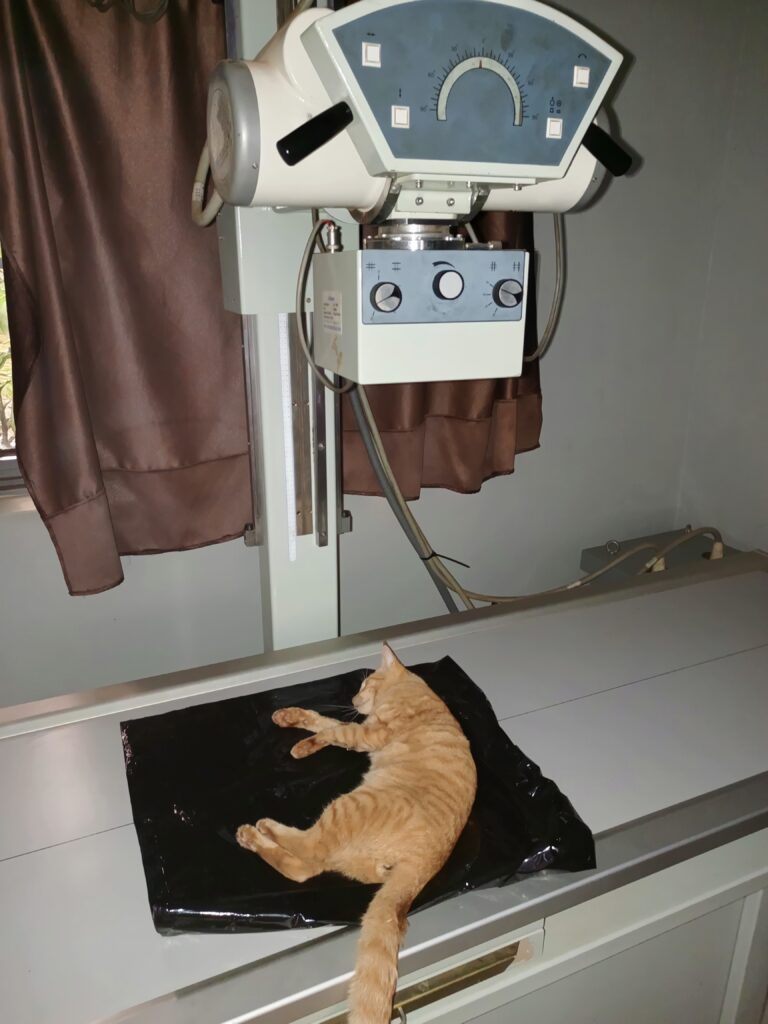
Step 5: Diagnostic Imaging (X-rays)
If a fracture, dislocation, or bone disease is suspected, X-rays are performed.
X-rays help identify:
- Fractures
- Pelvic injuries
- Hip dysplasia
- Luxating patella
- Bone tumors
- Severe arthritis
Without X-rays, many fractures may be missed — especially small hairline fractures.
Step 6: Blood Tests
If infection or systemic disease is suspected, blood work is done.
Blood tests help detect:
- Tick-borne infections
- Inflammation
- Organ function before giving medication
- Severe infection (abscess or septic arthritis)
In some cases, fever plus limping points toward infectious causes.
Step 7: Joint Fluid Analysis (Advanced Cases)
If septic arthritis is suspected, the vet may collect joint fluid.
This helps determine:
- Bacterial infection
- Inflammatory joint disease
- Immune-mediated conditions
This step is especially important when swelling is localized to one joint.
Step 8: Fine Needle Aspiration or Biopsy (If Cancer Suspected)
If there is persistent swelling or a bone lesion, further testing may be required to rule out tumors.
While less common, early detection improves outcomes significantly.
Why Proper Diagnosis Matters
Treating limping without diagnosis can be dangerous.
For example:
- Giving painkillers to a cat with a fracture may worsen bone displacement.
- Treating a joint infection as arthritis delays proper antibiotics.
- Missing a glass fragment can cause chronic infection.
Correct diagnosis ensures:
✔ Accurate treatment
✔ Faster recovery
✔ Lower long-term costs
✔ Prevention of permanent damage
FAQs About Limping in Cats in Kampala, Uganda
1️⃣ I am in Uganda and one of my two cats is limping but I cannot see any wound. What should I do and which vet do you recommend?
Even if you cannot see a wound, limping means your cat is in pain. Many problems — such as sprains, fractures, joint infections, nerve damage, or even a tiny glass fragment — may not be visible externally.
Here’s what you should do immediately:
- Restrict movement
- Check the paw gently for swelling
- Do NOT give human painkillers
- Monitor appetite and behavior
If limping lasts more than 24–48 hours, seek veterinary care.
In Kampala, many cat owners recommend Dr. Edward, a feline specialist at Superior Animal Clinic.
📞 +256771909946
Early diagnosis prevents complications and reduces long-term costs.
2️⃣ How much does it cost to treat a cat that is limping in Uganda?
The cost depends on the cause.
In Kampala, treatment may range between UGX 125,000 to UGX 450,000, depending on:
- Consultation and examination
- X-rays
- Blood tests
- Medication
- Surgery (if needed)
- Hospitalization
Minor paw injuries are on the lower end, while fractures requiring surgery are on the higher end.
Early treatment is always more affordable than delayed care.
3️⃣ My cat has been limping for 3 days. Do I need an X-ray or ultrasound? Where can I get it in Kampala and how much does it cost?
If your cat has been limping for 3 days, especially without improvement, diagnostic imaging is often necessary.
X-rays are recommended if:
- Fracture is suspected
- There is joint swelling
- There was a fall or accident
- The cat refuses to bear weight
Ultrasound is used when:
- Soft tissue injury is suspected
- There is internal swelling
- Abdominal trauma occurred
In Kampala, X-rays for cats are available at advanced veterinary facilities such as Superior Animal Clinic.
Typical imaging costs range from UGX 200,000 to 350,000, depending on the number of views taken and sedation requirements.
If limping persists beyond 48 hours, imaging is strongly advised.
4️⃣ Can a cat’s limp heal on its own?
Minor sprains may improve within 2–3 days with strict rest.
However, fractures, infections, abscesses, arthritis, and nerve injuries will NOT resolve without treatment. If the limp worsens or lasts more than 48 hours, see a vet.
5️⃣ Can tick fever cause limping in cats in Uganda?
Yes. While more common in dogs, tick-borne infections in Uganda can cause:
- Fever
- Joint inflammation
- Weakness
- Limping
If your cat also has reduced appetite or lethargy, blood tests are recommended.
6️⃣ Is limping always painful for cats?
Almost always.
Cats rarely fake limping. If they are avoiding putting weight on a leg, there is discomfort or instability.
7️⃣ What should I NOT give my limping cat at home?
Never give:
- Paracetamol (Panadol)
- Ibuprofen (Brufen)
- Diclofenac
- Leftover dog medication
These drugs can cause liver failure, kidney failure, stomach ulcers, or death in cats.
8️⃣ My cat is limping but still eating and playing. Should I still worry?
Yes.
Cats are very good at hiding pain. A cat can continue eating but still have a fracture, abscess, or deep paw injury.
Any limp lasting more than 24–48 hours requires veterinary examination.
9️⃣ What are the most common causes of limping in cats in Kampala?
In our local environment, the most common causes include:
- Road traffic accidents
- Cat fight abscesses
- Thorns or broken glass
- Falls from balconies
- Arthritis in older cats
- Sprains
- Joint infections
Outdoor cats in areas like Makindye, Rubaga, Ntinda, and Kira are especially at risk.
🔟 When is limping an emergency?
Seek immediate care if:
- The cat cannot stand
- There is visible deformity
- There is heavy bleeding
- The cat is crying in pain
- There is fever
- The cat stops eating
Emergency cases should not wait.
1️⃣1️⃣ Can indoor cats in Kampala get limping problems?
Yes.
Indoor cats can suffer from:
- Slipping on tiles
- Jumping injuries
- Balcony falls
- Nutritional bone weakness
Indoor does not mean risk-free.
1️⃣2️⃣ How can I prevent limping in my cat in Uganda?
- Keep cats indoors or supervised
- Remove sharp objects in compounds
- Provide balanced nutrition
- Regular parasite control
- Routine veterinary check-ups
Prevention is always cheaper than treatment.
Conclusion: Act Early When Your Cat Is Limping in Kampala
If your cat is limping in Kampala, Makindye, Ntinda, Muyenga, Kololo, Rubaga, Kira, or Wakiso, don’t ignore it. Limping is not a disease — it is a clear sign of pain or injury. It may be something minor like a thorn, or something serious like a fracture, infection, or arthritis.
In Uganda’s environment — with busy roads, sharp objects in compounds, and frequent cat fights — injuries are common. What seems small today can quickly become worse.
If the limp lasts more than 24–48 hours or is getting worse, seek veterinary care immediately. Early diagnosis and proper treatment reduce pain, prevent complications, and save money in the long run.
Your cat may not cry loudly — but limping is their way of saying, “Something is wrong.”