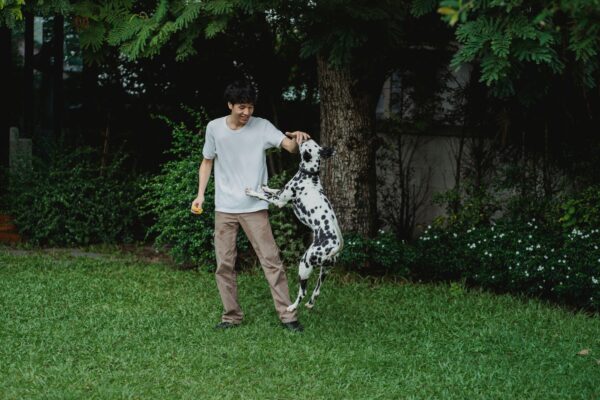
Nothing ruins a warm welcome faster than a dog launching itself onto visitors like a furry missile. While jumping may seem friendly and harmless, it can be frustrating for guests, knock over children, damage clothing, and create safety concerns.
While it’s often cute when they’re puppies, jumping can become dangerous especially with children, elderly visitors, or guests who are afraid of dogs.
The dog’s sharp nails make the action dangerous as they can leave wounds on the body. Medium and large sized dogs make the situation even more dangerous as they can easily knock over someone.
The good news is that jumping is a behavior that can be corrected with patience, consistency, and proper training.
Why Dogs Jump on Guests
Before fixing the behavior, let’s try to understand why dogs do it ,
Dogs often jump because:
- They are excited to see people.
- They want attention.
- They learned that jumping gets a reaction.
- They are seeking affection in the form of pets and belly ribs.
- Leftover puppy behavior that wasn’t corrected
- They have excess energy.
Even negative reactions such as pushing the dog away or shouting can accidentally reward the behavior because the dog still receives attention.
Why You Should Stop Jumping Behavior
Allowing your dog to jump on guests can lead to several problems:
- Visitors may become uncomfortable or frightened especially to people who naturally fear dogs. While your dog may seem harmful in your eyes , another person can see it as life threatening .
- Elderly guests can lose balance and fall easily .
- Children may get knocked over.
- Muddy paws can stain clothes and furniture.
- The habit can become harder to break over time.
Teaching polite greetings creates a safer and more enjoyable environment for everyone.
Step 1: Ignore the Jumping
One of the most effective techniques is to remove the reward. Never reward bad behavior,
When your dog jumps:
- Turn your back.
- Avoid eye contact.
- Keep your arms folded.
- Do not speak to the dog.
Completely ignore the dog and only give attention when all four paws are on the floor. Consistency is key and so everyone in the household and all visitors must follow this.
Your dog will quickly learn that jumping gets nothing, while calm behavior earns attention and affection. Violence is not necessary in this case.
Step 2: Reward Good Behavior
Dogs repeat behaviors that bring rewards.
When your dog greets someone calmly:
- Offer praise.
- Give treats.
- Pet them gently.
- Use a happy voice.
Immediate acknowledgement and praise will get your dog yearning for more. The goal is to teach your dog that keeping its paws on the ground is more rewarding than jumping.
Step 3: Teach the “Sit” Command
A sitting dog cannot jump at the same time.
Practice the sit command daily:
- Hold a treat above your dog’s nose.
- Move it slightly backward.
- As the dog sits, say “Sit.”
- Immediately reward the behavior.
When guests arrive, ask your dog to sit or stay before opening the door.
Over time, sitting will become the dog’s default greeting behavior.
Step 4: Practice with Family Members
Training works best when everyone participates.
Ask family members to:
- Enter the house repeatedly.
- Ignore jumping.
- Reward calm greetings.
- Follow the same rules consistently.
Dogs learn faster when they receive the same message from everyone. Don’t let other family members entertain such behavior or reward it .
Step 5: Manage Excitement Levels
Many dogs jump because they are overflowing with energy.
Before expecting polite greetings:
- Take your dog for a walk.
- Play fetch.
- Engage in a training session.
- Provide mental stimulation with puzzle toys.
A tired dog is usually a calmer dog. How often should you walk your dog ? Read this article to understand.
Step 6: Use a Leash During Greetings
If your dog becomes overly excited when guests arrive, use a leash for extra control.
The leash allows you to:
- Prevent jumping.
- Redirect attention.
- Guide the dog into a sit position.
- Reward calm behavior safely.
This management tool can be especially helpful while training is still in progress. It will also protect people from injuries or discomfort caused by a jumping dog .
Here is an affordable leash from our shop

Common Mistakes to Avoid
Many owners unknowingly make jumping worse.
Avoid:
- Giving attention while the dog is jumping. By shouting commands and giving attention.
- Allowing jumping sometimes but not always.
- Yelling or using harsh punishment.
- Rewarding excitement instead of calm behavior.
- Expecting instant results.
Consistency is far more effective than punishment.
How Long Does It Take to Stop Jumping?
Every dog learns at a different pace. The best way to avoid jumping problems is to teach good manners while your dog is still a puppy. But even adult dogs can learn new behaviors with patience.
Factors that affect training include:
- Age
- Breed
- Energy level
- Previous habits
- Consistency of training
Some dogs improve within a few weeks, while others may require several months of practice.
When to Seek Professional Help
If your dog:
- Becomes aggressive when corrected
- Is extremely difficult to control
- Jumps despite consistent training
- Shows anxiety around visitors
Consider working with a professional dog trainer or behaviorist.
Final Thoughts
Jumping on guests is a common behavior, but it doesn’t have to be permanent. By ignoring unwanted jumping, rewarding calm greetings, teaching a reliable sit command, and staying consistent, you can help your dog become a polite host instead of an enthusiastic trampoline.
Remember, every calm greeting is a step toward better manners and happier visits for both your dog and your guests.