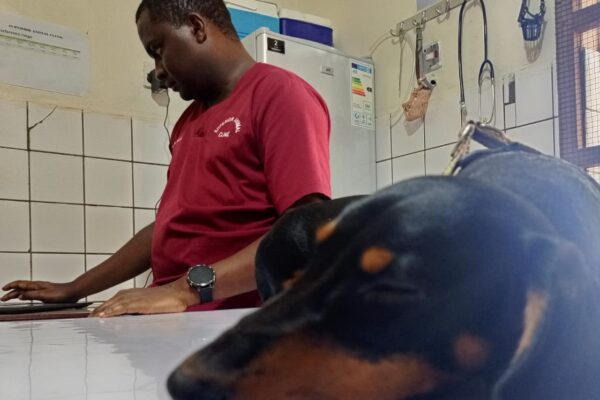
One of the most common things I hear from pet owners is: “Doctor, my neighbour’s dog had the same problem, and this is what they gave it. Can I give the same medicine to mine?”
Sometimes the owner has already searched Google. Or might have also asked AI and many pet onwers come up with different conclusions
“AI says this is probably an infection.”
“I saw online that this medicine works for dogs.”
“My friend’s dog had the same symptoms and recovered after taking this.”
As a veterinarian, I understand why this happens. When your dog is sick, you want an answer quickly.
But there is one important lesson I want every dog owner in Uganda to understand:
Two dogs can have the same symptom and still need completely different treatment.
This is one of the reasons I strongly caution against diagnosing and treating your pet based only on symptoms, social media, Google searches or AI. I covered this topic in my recent article about the dangers of diagonising pets using AI. If you havent already , read the full article here.
The Same Symptom Does Not Always Mean the Same Disease
Let’s take a simple example. Let me give you some scenarios ;
Two dogs are brought to a veterinary clinic because they are both vomiting.
It is tempting to conclude that they have the same problem.
- But one dog may have eaten spoiled food.
- Another may have swallowed an object.
- Another could have a parasite problem.
- Another could have an infection.
- Another could have a more serious underlying condition.
They all have one thing in common: They are vomiting.
But the reason they are vomiting may be completely different. And if the cause is different, the appropriate treatment may also be different. This is why veterinary medicine is not simply about matching a symptom with a medicine.
“But Doctor, My Friend’s Dog Had the Same Problem”
This happens quite often. A pet owner comes to the clinic and says: “My friend’s dog had exactly this problem. They gave it medicine X and it became fine.”
The difficulty is that you don’t necessarily know whether the dogs actually had the same disease.
The two dogs may have:
- Different ages
- Different breeds
- Different weights
- Different vaccination histories
- Different medical histories
- Different diets
- Different parasite exposure
- Different underlying conditions
- Different levels of dehydration
- Different severity of illness
Even if both dogs have diarrhoea, for example, their treatment may not be the same.
Your dog’s body is not a copy of your neighbour’s dog. Let me brekdown reasons why treatment might differ for different dogs
1. Breed Can Change the Veterinary Approach
Breed is another reason treatment cannot simply be copied from one dog to another.
Different breeds can have different anatomical characteristics, genetic tendencies and health risks.
Let’s use two common dog breeds in Uganda: a Maltese and a German Shepherd.
Both may arrive at the clinic breathing heavily.
But the veterinarian will not automatically assume they have the same problem.
A Maltese may be breathing heavily because of anxiety, pain, fever, heart disease, heat or another condition. A German Shepherd may also have these problems, but the veterinarian will additionally consider breed-related risks and other factors that may affect its breathing and overall health.
The symptom is similar. The clinical reasoning is different.
This is particularly important in Uganda, where some imported breeds may also struggle with our warm climate.
2. Age Matters More Than Many Owners Realise
A puppy and a senior dog can have the same symptom but require very different approaches.
Imagine two dogs with diarrhoea. One is a three-month-old puppy. The other is a ten-year-old dog.
The veterinarian will consider their ages when deciding what could be causing the problem and how serious it may be.
Puppies can become dehydrated quickly, and their vaccination status is particularly important when assessing certain illnesses.
An older dog may have underlying conditions that need to be considered.
So when someone says:
“My dog had the same thing and the vet gave him this medicine.”
My next question is: “How old was that dog?” Answer this before you come to treament conclusions.
3. Weight Also Matters
A 5 kg dog and a 35 kg dog cannot simply be treated as though they are the same patient.
Medication dosing in veterinary medicine can depend on body weight, but weight alone isn’t enough.
The veterinarian also needs to consider the medication itself, the condition being treated, the dog’s health status and other relevant factors.
This is why I don’t recommend taking medication prescribed for one dog and simply adjusting the amount for another dog at home.
Veterinary prescriptions are not recipes that can automatically be transferred from one animal to another.
4. Your Dog’s Medical History Matters
Imagine two dogs with skin problems.
One has never had a serious illness and has recently started scratching.
The other has been treated repeatedly for skin infections and has been taking several medications.
They may look similar when they walk into the clinic.
But their medical histories are completely different.
The veterinarian may therefore investigate them differently.
This is one reason I ask owners questions that may sometimes seem unrelated to the immediate complaint.
- When did it start?
- Has this happened before?
- What has the dog eaten recently?
- What medication has it received?
- When was it last vaccinated?
- When was it last dewormed?
- Does it interact with other animals?
These questions help us build the bigger picture.
This Is Where AI Can Be Misleading
This brings us back to something I discussed in my previous article:
Can you trust AI information about your pet’s health?
AI can be a useful educational tool. But one of its biggest limitations is that it may not have enough information about your individual animal.
You might type: “My dog has diarrhoea. What should I give it?”
AI may provide several possible causes and general treatment information.
The problem is that “my dog has diarrhoea” is not a diagnosis.
There are many questions behind that statement.
- How old is the dog?
- How long has it been happening?
- Is there blood?
- Is the dog vomiting?
- Is it eating?
- Is it drinking?
- Is it weak?
- Is it vaccinated?
- Has it been dewormed?
- What has it eaten?
- Has it been exposed to other dogs?
- Has it recently travelled?
- Has it received medication?
These details can completely change the veterinary assessment.

Even Two Dogs From the Same Household Can Be Different
This is something pet owners sometimes find surprising. You can have two dogs living in exactly the same home, eating the same food and exposed to the same environment.
One becomes sick. The other remains perfectly healthy.
Why?
Because they are individuals. Their age, immunity, previous health, genetics and individual circumstances may be different.
So even when two dogs have the same owner, the same home and the same symptoms, you shouldn’t automatically assume they need identical treatment.
What Does a Veterinarian Actually Look At?
When I examine a sick dog, I am not looking at the symptom alone. I am trying to understand the entire patient.
Depending on the complaint, this may include:
- Temperature
- Heart rate
- Breathing rate
- Hydration
- Gum colour
- Body condition
- Abdominal examination
- Skin and coat
- Eyes and ears
- Lymph nodes
- Weight
- Behaviour and alertness
- Vaccination history
- Parasite control
- Previous medical history
Sometimes we may need additional investigations such as blood tests, stool examination, skin tests, imaging or other diagnostic procedures.
The goal isn’t simply to identify what the dog is doing.
It is to determine why the dog is doing it.
Don’t Treat Your Dog Because Another Dog Was Treated That Way
This is particularly important when it comes to antibiotics, pain medicines, steroids and other medications.
A medicine that helped one dog may be inappropriate for another.
Using leftover medication from a previous illness can also create problems because the current illness may have a completely different cause.
And please don’t assume that because a medicine is commonly used by humans, it is automatically safe for your dog.
What I Recommend When Your Dog Becomes Sick
If your dog develops a concerning symptom, start by observing carefully.
Note:
- When the problem started
- How often it is happening
- Whether it is getting better or worse
- Changes in appetite
- Changes in drinking
- Vomiting or diarrhoea
- Changes in urination
- Changes in behaviour
- Any recent food changes
- Any possible exposure to toxins or unusual objects
- Recent medication
- Vaccination and deworming history
You can even use AI to help organise these observations into a clear summary.
Then give that information to your veterinarian.
That is a much better use of technology than asking AI to prescribe treatment.
The Bottom Line: Same Symptom, Different Patient
If there is one thing I want you to remember from this article, it is this:
A symptom is not a diagnosis.
But that does not mean they have the same disease or need the same treatment.
This is also why diagnosing your pet based solely on AI can be risky.
- AI can give you information.
- Google can give you possibilities.
- A friend can give you their experience.
But your dog is an individual patient.
A veterinarian has to put the symptoms, history, physical examination and, when necessary, diagnostic tests together before deciding on treatment.
Best Veterinary Care in Uganda
At Superior Animal Clinic, we believe good veterinary care starts with understanding the individual patient.
Whether your dog is a puppy in Kampala, an imported breed in Munyonyo, a family pet in Makindye, or a dog anywhere else in Uganda, our veterinary team can assess its symptoms, medical history and overall health before recommending an appropriate course of care.
Don’t treat the symptom alone. Find the cause.