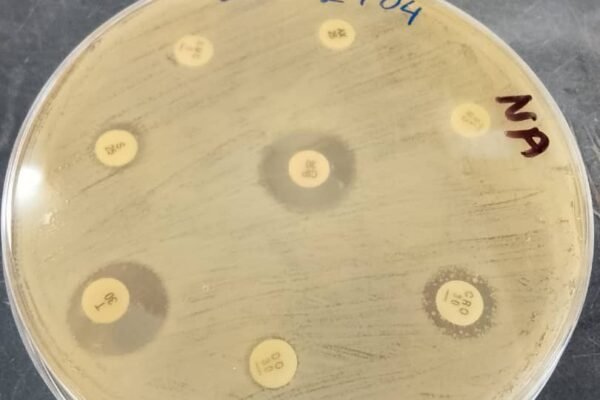
Last month we got 5 cases of 3 dogs & 2 cats presenting with flu / producing a thick yellow mucous. We gave a couple of antibiotics, over the admission period of one month but no improvement was seen. The sad part is all the animals succumbed to pneumonia. Where does this leave you as a pet owner. Let’s first look at what really happened
| Animal | Name | Age | Weight | Breed | Reason for Admission | Location |
|---|---|---|---|---|---|---|
| 🐕 Dog | Kobe | 3 months | 12 kg | Labrador Cross | Parvo | Buziga |
| 🐕 Dog | Weasel | 1.2 months | 2 kg | Golden Retriever | Parvo | Munyonyo |
| 🐕 Dog | Rapha | 5 months | 8 kg | German Shepherd | Vomiting | Bugolobi |
| 🐈 Cat | Demi | 10 months | 3 kg | DSH | Vomiting blood | Lubowa |
| 🐈 Cat | Betty | 7 months | 2.1 kg | Persian | Weak | Makindye |
How the flue was presented
It started with producing mucus in the right nostrils then shifted to the left nostrils and after 2 days it disappears on, then it comes back on the 3rd day when its strong, the animal’s front legs become paralyzed, the skin turns yellow and hemorrhages in the pinna.
But the animal maintained a good appetite and alert eyes, day later it dies.
This is an important reminder that an animal appearing alert or continuing to eat does not necessarily mean that a respiratory illness is resolving. Persistent or worsening respiratory discharge should still be assessed by a veterinarian.
How We Handled The Case
To best understand this case, we had to investigate and there was no better way than a postmortem, Yes a postmortem on cats and dogs.
What Did the Postmortem Examination Show?
Following the death of the animal, a postmortem examination was performed.
The veterinary team reported three notable findings:
- Red hepatization of the lungs
- A large amount of thick mucus in the trachea
- A yellow subcutaneous layer
These findings were consistent with significant changes involving the respiratory system.
Because the animals had not responded to the antibiotics that had been administered, further investigation was carried out rather than simply continuing with routine treatment.
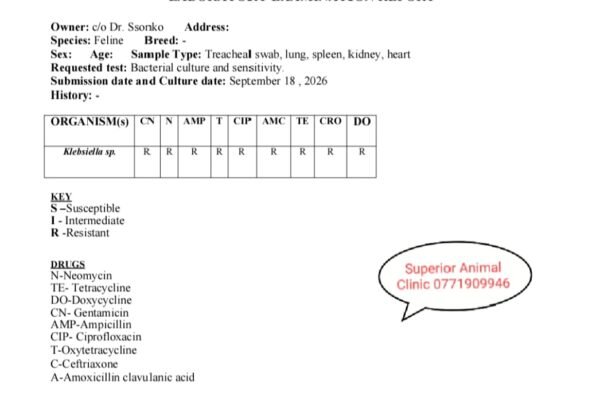
Laboratory report for multidrug resistant Klebsiela Spp in Uganda
Samples Were Collected for Bacterial Testing
Samples were collected for bacterial culture and sensitivity testing. The samples included material from:
- Tracheal swabs
- Liver
- Lungs
- Kidney
The purpose of culture and sensitivity testing was to investigate the bacteria involved and determine its response to available antibiotics.
The results reported that multi-drug resistant Klebsiella spp. was isolated.
This finding provided an important explanation for why the pneumonia had not responded to the routine medications used during treatment.
A Concerning Experience for Veterinary Practice in Kampala
For the veterinary team involved, this was reported as their first experience encountering pneumonia that was not responsive to the routine medication they were using.
The case serves as a reminder that veterinary medicine is continually evolving. When infections behave differently from what is expected, further investigation can be necessary to understand what is happening.
It also highlights the value of laboratory diagnostics in cases where an animal is not responding as expected to treatment.
Conclusion
The reported cases of dogs and cats in Kampala provides an important example of the challenges that can arise when bacterial infections are associated with multi-drug resistance.
Five animals were reported with flu-like signs and thick yellow mucus, followed by pneumonia that did not improve with the antibiotics initially administered. Further investigation, including postmortem examination and bacterial culture and sensitivity testing, resulted in the isolation of multi-drug resistant Klebsiella spp.
For pet owners, the key message is simple: persistent or worsening respiratory signs deserve veterinary attention, especially when an animal is not improving with treatment.
Early veterinary assessment and appropriate diagnostic testing can help clinicians better understand difficult infections and make informed treatment decisions.